Shade Guide
Retractable Awning Wind Ratings, Explained for Buyers
Before you spend a dollar, here's how much wind a retractable awning can handle, what the ratings mean in real weather, and the one option that makes the whole question stress-free.
Se habla español
Prefer text? Text AJ Shades at (909) 325-3110
Our team has earned 605 five-star reviews.
Owned
Made
on awnings & screens
five-star reviews
CSLB #951583
Ask ten homeowners what they worry about most before buying a retractable awning, and wind comes up more than fabric color, more than size, more than almost anything else. Retractable awning wind performance is the number-one pre-purchase question because it’s really a durability question in disguise: “Will this thing survive the weather here?” Fair. A retractable awning wind rating is the honest, tested answer to that question, and once you understand how to read it, the buying decision gets dramatically simpler.
This guide is written for the buyer, not the engineer. You won’t find spec-sheet jargon here. Instead, you’ll get the one wind-speed number that matters, what it looks and feels like on your patio, how rain plays into it, and why a small wireless device called a wind sensor has quietly become the real answer to the whole retractable awning wind worry. By the end, you’ll know exactly what to ask for in your quote, and exactly what you can stop worrying about.
Start with the number: about 25 mph
Here’s the straight answer, no hedging: residential retractable awnings are typically rated for moderate winds of around 25 mph (40 km/h) while extended. That figure comes from the EN 13561 wind classes, the European standard that grades awnings by the wind loads they’re built to take. Residential models sit in the moderate band; commercial-grade units can be engineered higher, but for a home patio, 25 mph is the honest working number.
Read that number the way you’d read the speed rating on a tire. It’s the top of the tested comfort zone, not a dare. An awning rated for 25 mph sails through a 12 mph afternoon breeze without noticing. It stays put in a 20 mph blow. And when the gusts start pushing past the number, the correct move is retraction, long before anything dramatic happens. The rating exists so you have a clear line. The smart play is living comfortably on the calm side of it.
What 25 mph actually looks like on your patio
Numbers on a spec sheet feel abstract; patios are not. So translate it. At 10–15 mph, leaves rustle and a flag stirs, perfect awning weather. At 20–25 mph, loose papers lift, small branches sway, and you start bracing your drink on the table. That’s the edge of the comfortable zone. Past it, branches swing hard, dust kicks up, patio umbrellas strain against their bases. That’s awning-in weather, full stop.
Here’s the rule of thumb we give every customer: if the wind is annoying your afternoon, it’s past the awning’s favorite weather. You don’t need an anemometer on the fence. You need one honest habit: when the patio stops feeling pleasant, retract the awning. Twenty seconds with a remote, and the whole question evaporates.
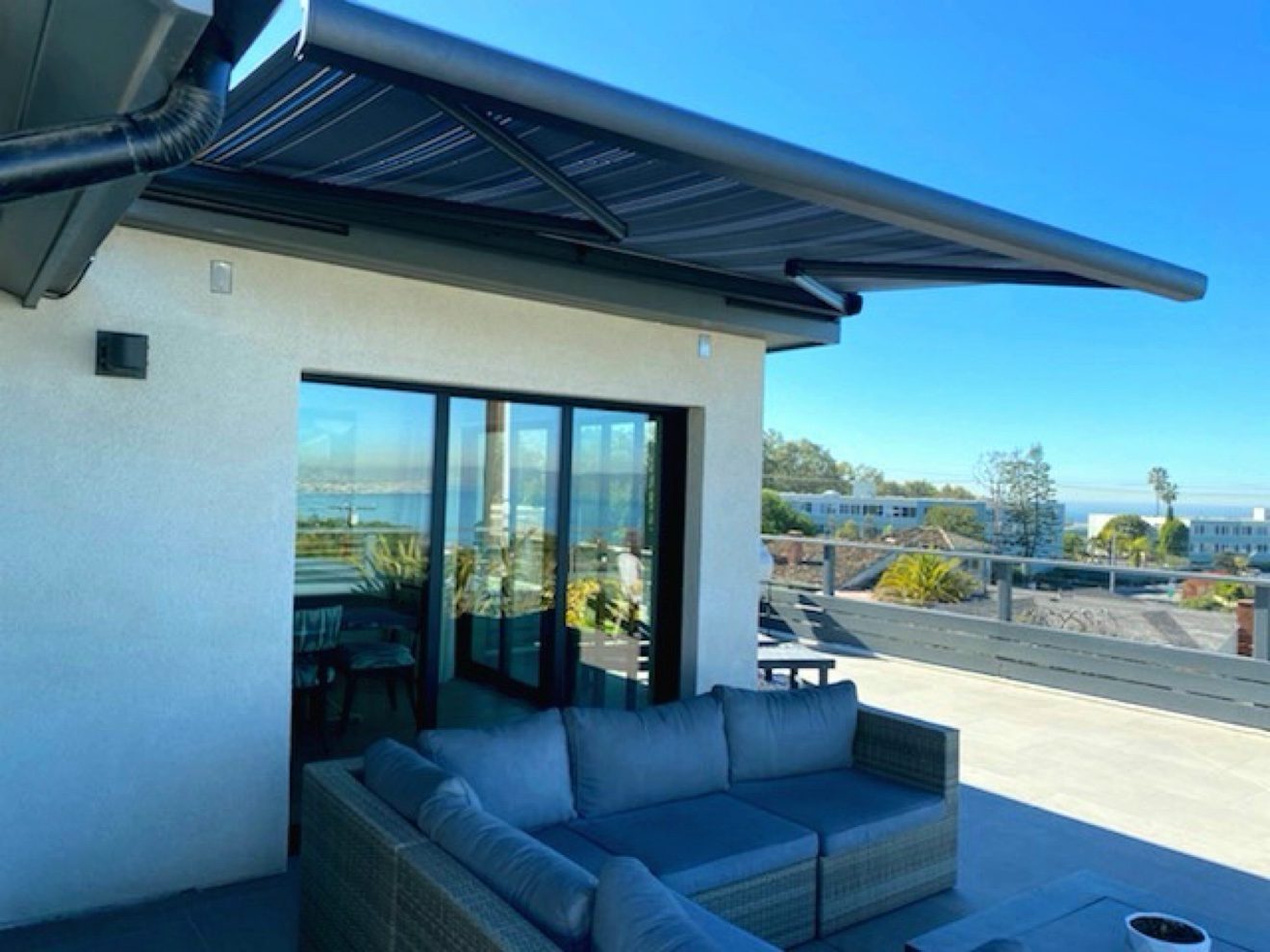
The rating is a retraction rule, not a bragging right
Most buyers read a wind rating backwards. They treat it like a toughness score, higher means a stronger awning, and the strongest awning wins. In practice, the rating is much more useful as a retraction rule. Every retractable awning, at every price point, is designed to come in when conditions exceed its envelope. The awnings that last fifteen years aren’t the ones with the biggest numbers on the brochure. They’re the ones that get retracted on time, every time.
That reframes the buying question entirely. Instead of “Which awning can take the most wind?”, ask “How reliably will this awning get itself in when the wind builds?” The first question leads to spec-sheet shopping. The second leads to the feature that actually protects your investment, which brings us to the sensor.
The weak link isn’t the awning. It’s your schedule.
Wind ratings assume one thing that real life rarely delivers: a person standing by, ready to retract. Storms have no respect for your calendar. Pop-up thunderstorms roll through at 3 PM while you’re at the office. Gust fronts arrive at 2 AM while you’re asleep. Monsoon-season microbursts go from dead calm to patio-furniture weather in fifteen minutes. Across our service area, the awning-damaging events we hear about almost never happen while the homeowner is watching the sky. They happen while nobody’s home.
That’s the gap a rating alone can’t close. The number tells you where the line is. But if you’re not there to see the line approaching, the number can’t help you. This is exactly why wind sensors exist, and why we consider them the single most important option on any motorized awning sold in storm-prone territory.
The wind sensor: the answer that made the question simple
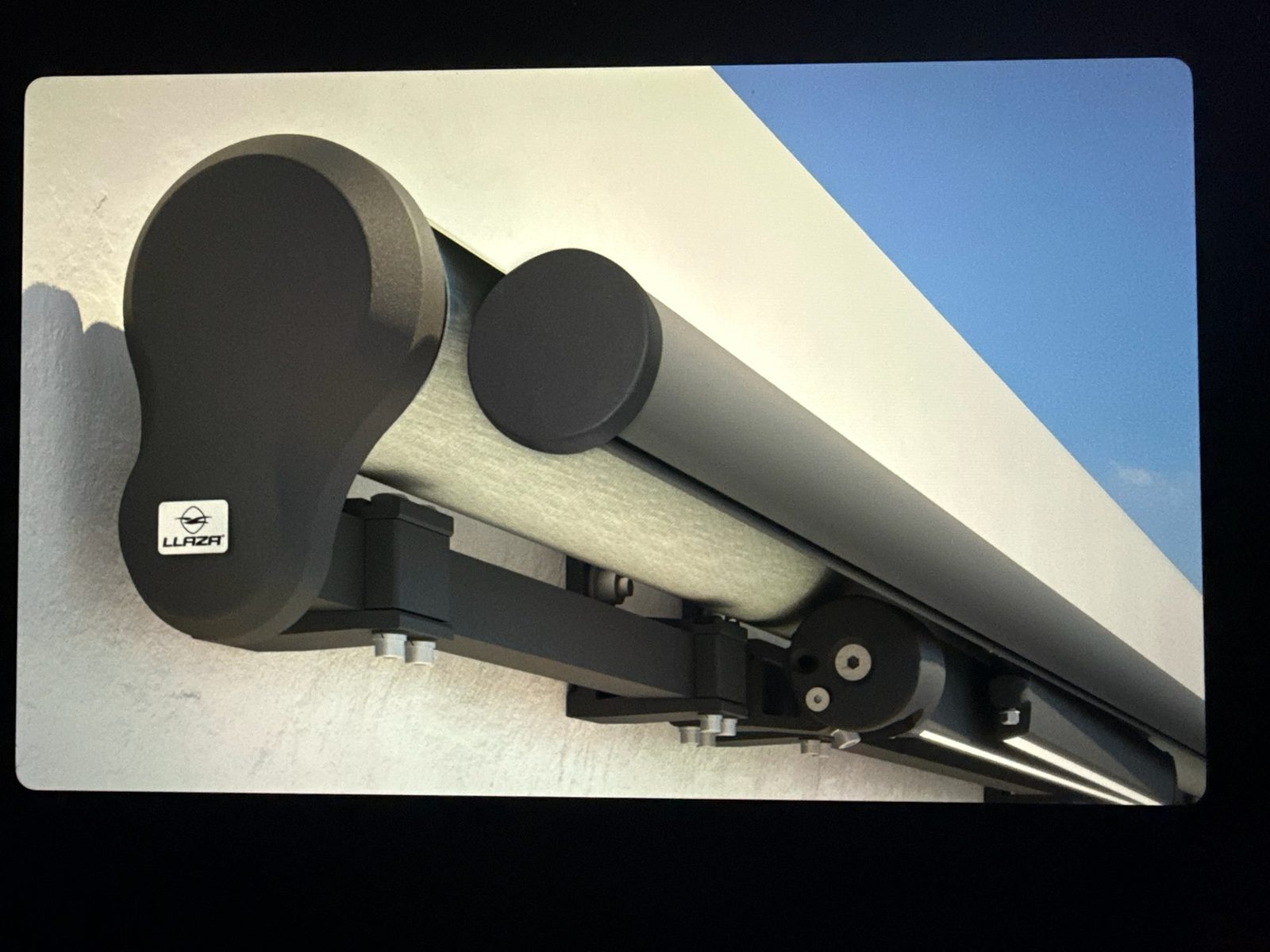
A wind sensor is a small wireless device that clips onto the awning’s lateral arm and feels for shaking. When gusts push the arm past the threshold you set, the sensor signals the Somfy-powered motor to reel the awning in, on its own. No app to open. No remote to find. No you required. It’s genuinely set-and-forget storm protection, and on a retractable awning it turns the wind question from a daily judgment call into a one-time setup decision.
We set the sensor threshold conservatively, well inside the awning’s rated envelope, because the sensor’s job isn’t to flirt with the limit. Its job is to make the limit irrelevant. And here’s what surprises most buyers: the sensor is one of the least expensive parts of the whole system, yet it’s the only part working while you sleep. If you take one buying rule from this page, make it this one: never order a motorized awning without the wind sensor.
Rain rules: drizzle is fine, downpours are not
Wind gets the headlines, but rain deserves a mention because the rule is just as simple. Light rain? Leave the awning out. Quality acrylic fabric sheds water and dries quickly, and a passing shower won’t hurt a thing. Heavy rain? Bring it in. The danger isn’t the water hitting the fabric, it’s the water collecting on it. When rain outpaces runoff, it ponds in the middle of the fabric, and a pooled pocket of water gets heavy fast, straining the arms, the roller tube, and the mounts.
One more rain habit worth building: if a storm forces you to retract a soaked awning, extend it the next dry morning and let it air out. Fabric that sits damp inside a closed housing for days invites mildew. Five minutes of morning sunshine, years of fabric life. Simple trade.
Motorized or manual: pick by your lifestyle, not your budget
The awnings themselves handle wind about equally well, so this decision comes down to one question: are you reliably around when weather turns? If you work from home, you’re usually on the patio anyway, and you don’t mind cranking, a manual awning on a well-built frame is a perfectly good buy. You are the sensor.
But if you commute, travel, or just don’t want to babysit the sky, the motorized-plus-sensor combination is the safer spend. It’s the only setup that protects itself while you’re gone, and around here, that’s when storms do their damage. Don’t buy the manual awning and then spend every windy afternoon worrying about it, buy the system that matches how you actually live.
Storm-night power outage: the manual override
The one fair objection to “the motor handles it” is the storm that knocks out your power. Quality motorized awnings answer that with a manual override: a hand crank or battery backup that lets you retract the awning by hand until the grid comes back. It’s a small feature that matters most in the exact moment it’s needed.
Put this on your quote-comparison checklist. Ask every bidder: “If the power dies in a storm, how do I get this awning in?” An awning with no answer to that question is an awning you can’t protect when it needs protecting most.
The windy-side upgrade: pair a drop screen
Some patios have one side that catches everything, a west-facing opening where the afternoon breeze turns into an evening howl. For those patios, the power move is pairing the awning with a motorized drop screen on the exposed side. The screen drops down and takes the brunt, cutting wind, blocking low sun, and keeping bugs out, while the awning overhead handles the top. Together they turn the windiest corner of the patio into the most-used corner.
Buying smart: the estimate that reads your exposure
Not every wall sees the same wind. A patio tucked behind a two-story house sits in a wind shadow; an exposed mount on a ridge catches everything the pass sends through. That’s why a real quote starts with a real visit. Our free in-home estimate includes an honest read of your property’s exposure, sun, orientation, surrounding structures, and the direction storms actually travel across your lot, and the hardware, motor, and sensor get sized to your home, not to a showroom average.
Every retractable awning we install carries our 15-year warranty, so we have every incentive to spec it right the first time. Financing is available for qualified buyers, ask about rates as low as 0% for 24 months, so the sensor and motor that make wind a non-issue don’t have to wait for next year’s budget. And because we’re a veteran-owned, American-made shop, the quote you get is written by the people who’ll be on your roof installing it, not a call center reading a script.
Awning Wind FAQ
Wind, rain, and sensor questions, answered
How much wind can a retractable awning handle?
Can I leave my retractable awning out in the rain?
Do retractable awnings come with wind sensors?
Motorized or manual - which handles wind better?
What if the power goes out in a storm?
How do I get a retractable awning quote?
Free estimate • No pressure
Get an awning quote that includes your wind exposure.
Free in-home estimate, honest read of your property's exposure, motor and sensor sized to your home. No pressure, no ballpark guessing.
Text AJ Shades
(909) 325-3110
Se habla español
Built by Family. Designed for Yours.
Owned
Made
on awnings & screens
five-star reviews
CSLB #951583