Shade Guide
Awning Mounting Options: Wall, Eave & Roof
Where your awning attaches to the house decides how strong it is, and what the install costs. Here's the honest breakdown of all three mounts, and what tile roofs change.
Se habla español
Prefer text? Text AJ Shades at (909) 325-3110
Our team has earned 605 five-star reviews.
Owned
Made
on awnings & screens
five-star reviews
CSLB #951583
Every retractable awning is a sail bolted to your house, and where it bolts on matters as much as the awning itself. There are three ways to mount one: to the wall, to the eave, or to the roof. Each one is the right answer for a different house, and each one carries a different cost, because the mounting work is genuinely different. Here’s exactly how each works, and why some cost more than others.
Wall mount: the standard
This is the default, and the baseline every quote starts from. Awning brackets get lagged straight into the wall’s framing, studs, a rim joist, or solid blocking, spreading the load across multiple anchor points. A wall is the strongest, most predictable thing on your house to hang an awning from: the framing is continuous, the bolts go deep into real lumber, and the physics are straightforward.
Whenever the wall allows it, this is what we install. It’s the cleanest look, the most direct load path, and the standard-cost installation, no reinforcement work, no roof penetrations, no extra hardware beyond the awning’s own engineered brackets. If your house has a solid wall where you want shade, the decision is already made.
Eave mount: same awning, reinforced eave
Sometimes the wall won’t cooperate, or you want the awning tucked up at the eave line for a cleaner look or a better projection angle. That’s the eave mount: the awning hangs from the eave instead of the wall.
Here’s what most quotes gloss over: an eave can’t hold an awning the way it comes from the builder. Fascia boards are trim, not structure, and the eave framing alone was never designed to take the torque an extended awning generates. Before a single bracket goes on, we have to reinforce the eave to carry the load across, tying into the rafter tails, adding solid blocking, and building a continuous structural path that spreads the awning’s pull-out force across the roof framing instead of concentrating it on a few inches of trim.
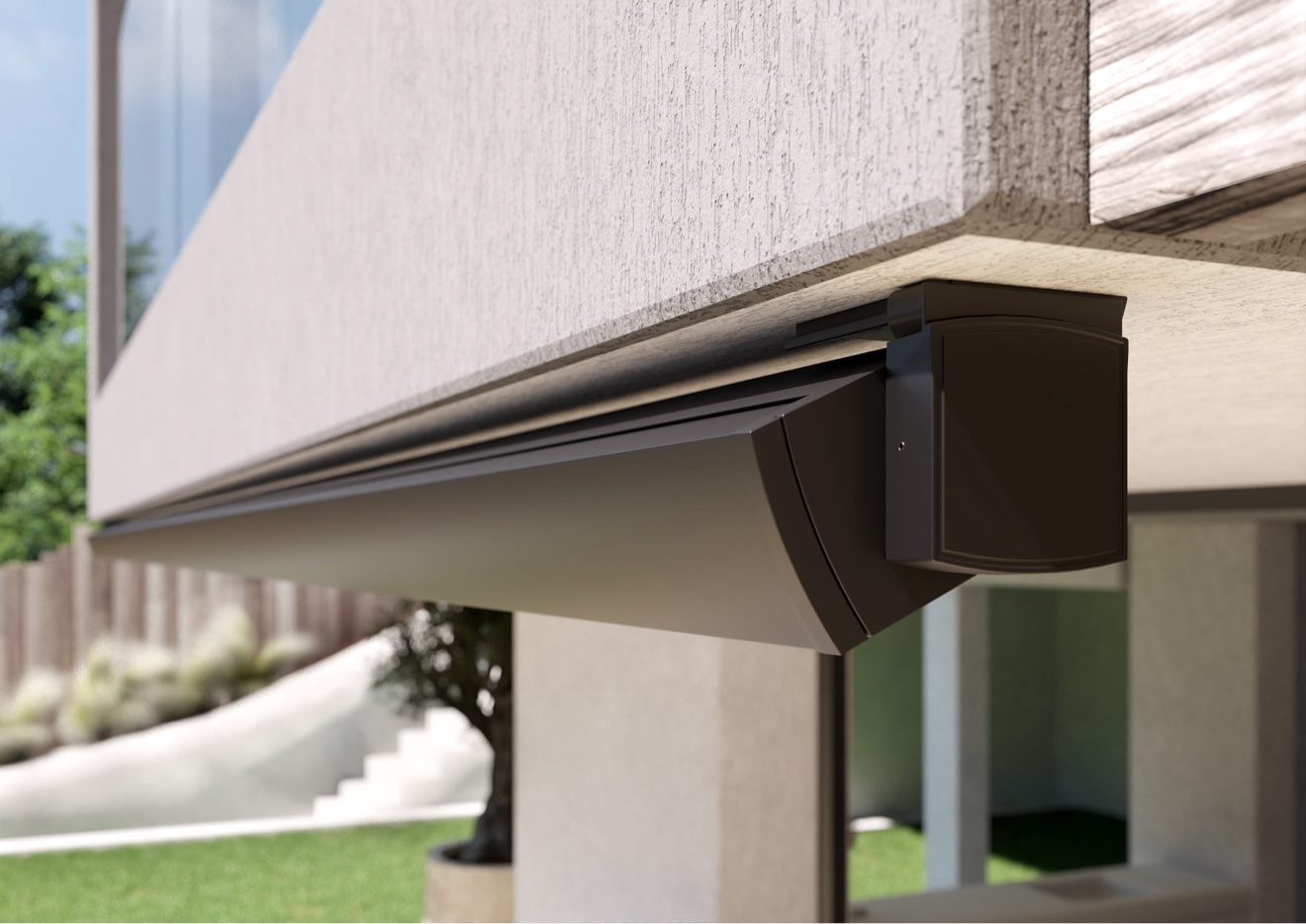
An awning cassette mounted at the eave line, the bracket above it ties the whole assembly back into reinforced structure, not just the fascia.
That reinforcement is real carpentry on top of the awning install, opening things up, adding lumber, fastening it right, and it’s why an eave mount carries an additional charge. You’re not paying more for the awning. You’re paying for the structure it hangs from being made strong enough to hold it through Santa Ana season.
Roof mount: when the wall can’t take it
Every so often a house has no usable wall where the shade needs to go, tall two-story walls, framing that lands in all the wrong places, or a layout where only the roof puts the awning where you want it. That’s what roof mounts are for.
Specialized roof-mount brackets anchor through the roofing material and fasten directly to the rafters underneath, so the awning rides on the roof structure itself. The brackets are engineered for the job, stout steel, properly flashed, because every bracket is a penetration through your roof, and a roof penetration done casually is a leak waiting for the first rain. Each one gets flashed and sealed like the roof’s integrity depends on it, because it does.
Roof mounts carry an additional charge: the brackets themselves, the structural fastening into rafters, and the flashing and sealing work at every penetration. It costs more than a wall mount, and it’s worth every penny next to the alternative, which is an awning attached to something that can’t hold it.
Clay and concrete tile roofs: cut, mount, seal
A huge share of SoCal homes wear clay or concrete tile , beautiful, durable, and completely unforgiving of sloppy mounting. You cannot drill through tile. It cracks, it shatters, and a cracked tile is a roof leak with a head start.
Mounting on a tile roof means each tile at a bracket location gets carefully lifted or cut, the bracket gets mounted to the roof structure underneath, and the whole assembly gets flashed and sealed watertight before the tile goes back into place. It’s slow, skilled, hands-on work, and there’s an additional cost for it, on any mount type, whenever we’re cutting into tile. Done right, the roof is as watertight as the day it was laid. Done cheap, it leaks, and the leak shows up long after the installer is gone.
Free estimate • No pressure
Not sure which mount your house needs? We'll tell you.
Free estimate: we check your wall, your eave, and your roof, then quote the right mount honestly, with any additional charges spelled out up front.
Text AJ Shades
(909) 325-3110
Se habla español
Built by Family. Designed for Yours.
Owned
Made
on awnings & screens
five-star reviews
CSLB #951583
The bottom line
Wall mount is the standard and the baseline, it’s what most homes get, at the standard installation cost. Eave mounts need the eave reinforced to carry the load across, roof mounts need specialized brackets anchored to rafters with serious flashing, and tile roofs need careful cutting and sealing. Each of those is additional work with an additional charge, and any honest quote spells it out instead of burying it.
Here’s the question to ask any installer, word for word: “Which mount are you quoting me, and what did you have to add to make my house hold it?” The good ones will walk you through the wall, the eave, or the roof and show you exactly where the money goes. The others will tell you “it’s all included”, and you’ll find out what wasn’t included the first time the wind picks up. We’d rather show you the brackets.
Mounting FAQ
Questions about awning mounting options
Which awning mount costs the least?
Why does an eave mount cost extra?
Can you mount a retractable awning on the roof?
What if I have a clay or concrete tile roof?
How do I know which mount my house needs?
Free estimate • No pressure
Mounted right, guaranteed for fifteen years.
Free on-site estimate: we'll assess your wall, eave, and roof, engineer the right mount, and put it all in writing, backed by our 15-year warranty.
Text AJ Shades
(909) 325-3110
Se habla español
Built by Family. Designed for Yours.
Owned
Made
on awnings & screens
five-star reviews
CSLB #951583